

Use a real recipe without confusing expansion relevance
The current Retail update stream is Midnight, with 12.1.5 notes and October 1 hotfixes. This example uses a housing recipe available to Modern WoW, rather than treating an old-expansion combat buff as a current raid recommendation.[2]
Blizzard lists one Sintallow Candles craft under Shadowlands Alchemy: 9 Arden Lumber, 4 Ground Widowbloom, 6 Sealing Wax, and 2 Shrouded Cloth. The pictured red candles are the named decor output; making two requires twice those listed quantities.[1]
Buy only the missing inputs for two crafts
All prices and owned quantities below are explicit arithmetic assumptions, not a live US, EU, or Korean auction quote. The route buys Ground Widowbloom as the listed intermediate input; it does not also buy and charge for the herbs used to produce that input. The three owned units are reserved for these crafts.
| Input | Needed for two | Owned | Buy | Assumed unit price | New spend |
|---|---|---|---|---|---|
| Arden Lumber | 18 | 6 | 12 | 20g | 240g |
| Ground Widowbloom | 8 | 3 | 5 | 40g | 200g |
| Sealing Wax | 12 | 8 | 4 | 5g | 20g |
| Shrouded Cloth | 4 | 4 | 0 | 10g | 0g |
Ignoring stock would cost 18×20 + 8×40 + 12×5 + 4×10 = 780 gold. Subtracting the actual assumed stock reduces new reagent spending to 240 + 200 + 20 = 460 gold. The three owned Ground Widowbloom alone remove 120 gold from the purchase. Do not reserve that same stock for another craft at the same time.
Assume an agreed 100-gold fee for a crafter to make both decor items: the additional crafting outlay is 560 gold. Self-crafting removes that fee and costs 460 gold in new materials. Agree how the reagents and finished items will change hands; if using an in-game order, include the separately displayed posting charge.
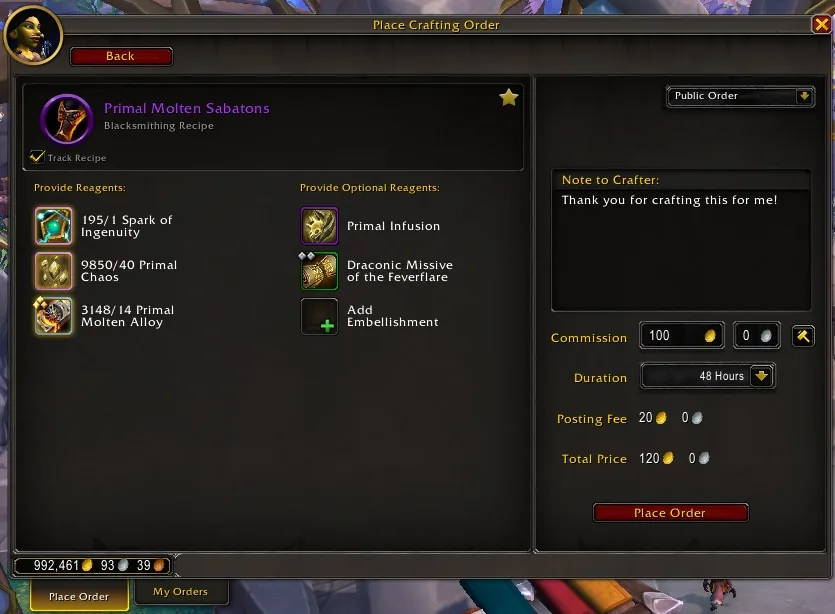
Blizzard’s pictured Dragonflight order has separate Commission and Posting Fee fields, showing 100 and 20 gold respectively. Those historical screen values illustrate the distinction; 20 gold is not assumed to be a current universal recipe fee.[7]
If the exact same finished decor costs an assumed 750 gold each, buying two costs 1,500 gold. The 560-gold commissioned route uses 940 gold less new cash. That is a spending-budget comparison. For profitability, owned materials also have the opportunity cost of what selling them would earn.
Add the weekly consumable shortfall
Potent Healing Potion is a named Midnight consumable in Blizzard’s hotfixes. For this example, plan ten for the week, subtract four usable potions already owned, and buy six. At an assumed 150 gold each, that is 900 gold instead of 1,500. Ten is the example’s chosen basket, not a universal dungeon-use recommendation.[6]
The completed basket is 560 gold for the decor craft plus 900 for potions: 1,460 gold. Subtract 500 spendable gold and 200 auction proceeds already collected to get a 760-gold shortfall. An unsold item listed for 300 gold is not collected income, so it does not reduce that shortfall.
Real-money gold purchases from third parties violate Blizzard’s rules and can bring account penalties. Keep that rule separate from the budget calculation; the amount being compared is the actual shortfall.[5]
View WoW Retail Gold optionsMatch the market, item, and quality
Retail commodity auctions—including stackable herbs, potions, and ores—are shared regionwide. Non-commodity markets such as equipment remain realm-specific. Use prices for your character’s region and the exact item variant instead of importing a quote from another region.[3]
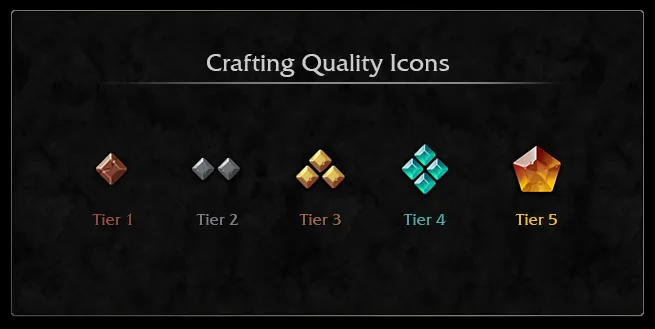
Blizzard’s Dragonflight quality chart illustrates the quality icons. Where your actual recipe uses quality, compare a finished item of the same quality with the craft that produces it. Do not invent a three-star or five-star version of Sintallow Candles for this calculation.[7]
Compare both routes as complete baskets
| Route | Decor spend | Potion spend | Total | Shortfall after700g |
|---|---|---|---|---|
| Commissioned craft | 560g | 900g | 1,460g | 760g |
| Buy finished decor | 1,500g | 900g | 2,400g | 1,700g |
Count a Token only after its sale completes
A Retail WoW Token shows a gold quote before listing, but a sale may take several days. Pending Token gold is therefore not a spendable balance for today’s material purchases.[4]
Replace the assumed unit prices with same-session prices, add the actual crafting charge, and subtract only supplies allocated to this project and gold already available. That finished figure, with the correct region and recipient character, is the useful amount to compare with gold options.
View WoW Retail Gold options