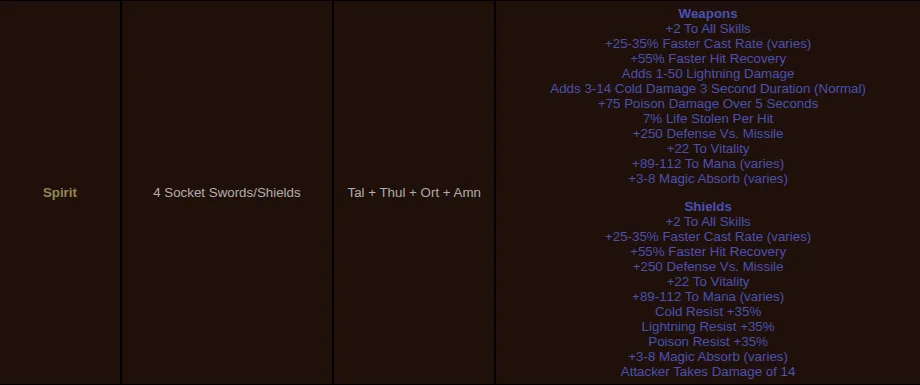
Do not compare a completed Diablo II: Resurrected runeword by name alone. First identify its intended character or mercenary, then require an uncropped item screen showing the exact base, requirements, ethereal status, durability where applicable, and every modifier. The base can change damage, defense, requirements, speed, or range, while two copies of the same runeword can show different values where the formula has variable properties.23
Start with the character or mercenary
Write down the destination before judging an offer: character class or mercenary type, build purpose, available Strength and Dexterity, equipment slot, and whether the user can tolerate durability loss. A character can equip an item only when its requirements and any class restriction are satisfied.6
- For a weapon, decide which damage, speed, range, skill, or aura properties actually serve the build.
- For armor, helms, and shields, compare defense and requirements alongside the runeword properties.
- For a mercenary, confirm that the mercenary can equip the item type and meets its requirements.
- For an ordinary character, decide whether the item must remain repairable or has a supported way to avoid durability loss.
What the runeword name proves
A valid runeword name shows that the required runes were placed in the correct order in an allowed non-magical base with exactly the required number of sockets. Runewords do not activate in Magic, Rare, Set, or Unique items, even when those items have the apparent socket count.2
The name does not identify whether the chosen base is Normal, Exceptional, or Elite, whether it is superior or ethereal, or whether its requirements and variable values suit your setup. Blizzard’s runeword documentation specifically notes that an allowed formula can be applied to different qualifying bases and that superior base properties remain relevant.2
Compare the three ways to obtain the item
| Field | Completed item from a listing | Make it in-game | Trade or farm in-game |
|---|---|---|---|
| Base and quality | Accept only the exact base shown on the finished tooltip | Choose the qualifying base before inserting runes | Restrict the search or trade to the required base |
| Socket condition | Confirm the completed runeword and visible base details | The base must have exactly the formula’s socket count | Check the finished item rather than trusting its name alone |
| Ethereal status | Inspect the tooltip and decide by intended user | Choose ethereal or non-ethereal before construction | State the required ethereal state in the trade |
| Variable rolls | Evaluate the finished values before deciding | Final variable values are not known until the runeword is made | Inspect each finished candidate line by line |
| Main control | Choice among the completed items actually presented | Control over the base and rune order | Control over the requested specification |
| Material drawback | Hidden or cropped fields prevent a reliable match | An incorrect base, socket count, rune, or order can waste the inserted runes | Finding a matching finished item can require additional trading or farming |
| Policy condition | External real-money transactions conflict with Blizzard’s current EULA | Uses items obtained within the game | Keep the exchange within Blizzard’s permitted game environment |
The largest drawback applies before price or roll quality: Blizzard’s English-language EULA, retrieved August 31, 2026, prohibits selling service-provided content for real money or exchanging it for value outside the game.1 That condition makes obtaining or trading for the item within the game the safer policy choice.
Compare current D2R item listingsCheck the base and sockets on one current screen
Ask for a fresh, uncropped screen containing the entire item tooltip. It should let you reconcile the runeword name, base name, damage or defense, requirements, ethereal label, durability where shown, and all modifiers without joining fragments from different images.
- Match the base name to the item type allowed by the runeword formula.
- Confirm that the finished properties and gold runeword name are visible; a seller’s socket-count label is not a substitute for the item screen.
- Record weapon damage or armor defense exactly as displayed rather than substituting a generic base value.
- Record Strength, Dexterity, level, and class restrictions that matter to the intended user.
- Check for superior base properties and include them when comparing two finished copies.
- Reject evidence that crops out the base name, requirements, ethereal label, or relevant modifiers.
When making the item yourself, the formula requires the exact socket count, correct item type, correct runes, and correct insertion order. A four-socket base cannot activate a three-rune formula merely because it has enough space.2
Ethereal is a benefit only for the right user
Ethereal weapons receive higher base damage and ethereal armor receives higher base defense, but ethereal equipment has reduced durability and cannot normally be repaired.3 That tradeoff can make an ethereal base appealing for one destination and unsuitable for another.
| Intended user | Potential benefit | Material drawback | Decision |
|---|---|---|---|
| Mercenary | Can use the ethereal base’s higher fundamental damage or defense | The mercenary must still be able to equip the item and meet its requirements | Consider ethereal when the exact base and finished properties fit |
| Ordinary character | Higher base damage or defense may help the build | Ethereal durability cannot normally be repaired | Prefer non-ethereal unless the finished item has a clearly supported durability solution |
| Character using an indestructible base | No ordinary durability-management burden | Not every qualifying item type or runeword has such a base option | Verify the exact base rather than assuming the runeword name settles it |
Hireling equipment does not lose durability, which is why ethereal equipment has a distinct mercenary use case.4 For a player character, do not treat that mercenary exception as transferable.
Read variable rolls line by line
Separate the tooltip into three groups: properties inherited from the base, fixed properties supplied by the runes and formula, and values that vary between completed copies. Blizzard’s runeword listings mark variable ranges for affected modifiers, so the actual finished tooltip—not a perfect-roll reference—is the evidence for the copy being considered.2
- Prioritize a variable aura or skill level when that effect is the item’s main job.
- Prioritize enhanced damage on a weapon only after confirming that the base, speed, range, and requirements fit.
- Prioritize enhanced defense only after comparing the actual displayed defense and equipment cost of the base.
- Treat secondary rolls according to the build’s real shortage; a larger number is not automatically more useful.
- Do not combine the best values from several screenshots into an imaginary single item.
Avoid unsupported breakpoint promises. Base weapon speed is only one input: total attack speed also depends on other equipment and the character context.5 Calculate a breakpoint only with a current, build-specific source and the character’s complete setup.
Reconcile one completed item
- Name the intended character or mercenary and the item’s job.
- Copy the exact base name and quality from the tooltip.
- Record displayed damage or defense, requirements, ethereal state, and durability.
- Transcribe every modifier and flag each important variable value.
- Compare the result with the character’s current equipment and stat budget.
- Confirm the game mode and destination separately if the transfer depends on them.
- Stop if the evidence cannot be tied to the same completed item.
The same discipline helps with other item economies. The comparison between crafting and acquiring a finished item is explored in the
Chaos, Divine, and Exalted Orb decision guideFor a separate example of matching every listing field to current evidence, use the
ARC Raiders item-listing verification guideWhen to leave the offer
- The base name or quality is cropped or described only in listing text.
- The item is called ethereal without a visible ethereal label, or the label is hidden.
- A key variable value is absent, blurred, or replaced by a claimed perfect-roll percentage.
- The intended character or mercenary cannot meet the displayed requirements.
- The item’s durability drawback conflicts with ordinary character use.
- Screens appear to show different copies of the item.
- The transaction requires account credentials or activity prohibited by Blizzard’s current terms.1
Choose the route that preserves the important fields
Choose a completed runeword only when its full tooltip already proves the exact base, ethereal state, requirements, and build-relevant rolls you need. Make it in-game when control over the base matters more than knowing the final variable rolls in advance. Trade or farm in-game when you want a finished item while staying within Blizzard’s game environment.
Review current D2R runeword optionsIf a decisive field remains hidden, do not let the runeword name or a headline roll settle the purchase. Move to an item whose complete tooltip matches the intended user—or obtain the required specification in-game.
