
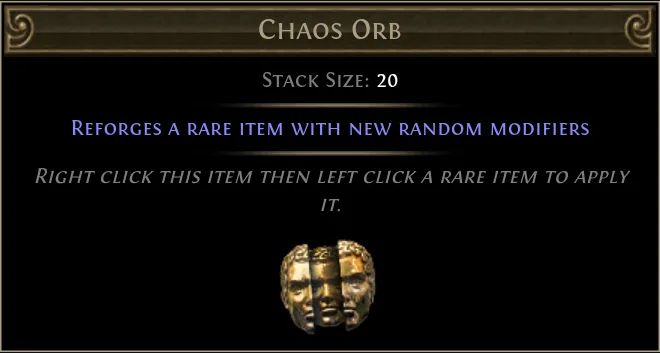
Before committing currency, match the game, league, platform market, item and quantity. Then compare the value you would consume—including repeat attempts and prerequisite crafts—with the current price of an item that already meets the goal. Exchange ratios and listings are player-driven conditions, so check the live market rather than relying on a remembered conversion.[4]
How the three orbs differ
| Orb | Direct effect in Path of Exile 1 | Item condition | Practical trade role | Value at risk when used | Main drawback | Choose instead when |
|---|---|---|---|---|---|---|
| Chaos Orb | Reforges a rare item with new random modifiers.[1] | An eligible rare item | Often used for lower-denomination pricing and exchange, but the live league market decides its current value.[1] [4] | One Chaos per attempt, plus the loss of the item's previous random modifiers | The new modifier set is unpredictable; repeated attempts can exceed the price of a suitable finished item. | Buy the finished item or use a more targeted craft when important modifiers must be preserved. |
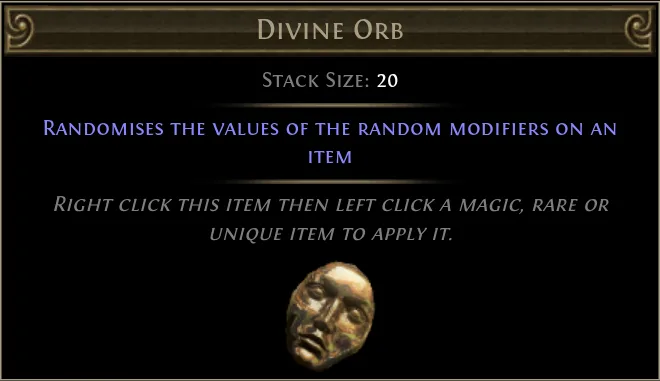
| Divine Orb | Randomises the values of an item's existing random modifiers.[2] | An eligible magic, rare or unique item; the effect changes values rather than adding a new modifier.[2] | Commonly used to quote higher-value trades, with its exchange value set by the current market.[2] [4] | One Divine per reroll | A worse roll is possible, and the orb cannot supply a missing modifier. | Use Exalted only when the item is rare, has room and truly needs an additional random modifier; otherwise buy the required roll. |
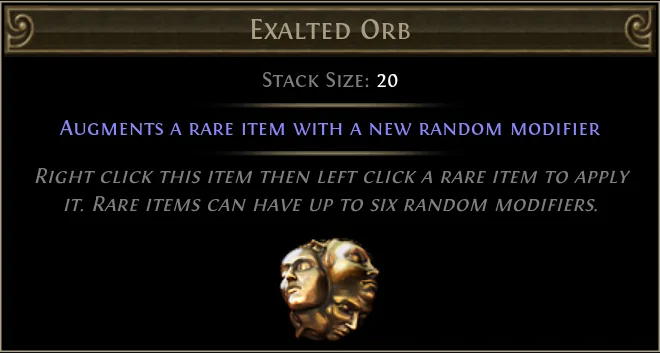
| Exalted Orb | Adds one new random modifier to a rare item.[3] | An eligible rare item with an available modifier slot; ordinary rare items can have up to six random modifiers.[3] | May appear in listings or currency exchanges, but its denomination role and conversion value remain market-dependent.[4] | One Exalted and the opportunity to sell or exchange it | The added modifier is random and may contribute little to the item. | Keep the item unchanged or buy a finished item when the added modifier must be specific. |
When a Chaos Orb fits
Chaos fits a trade quoted in Chaos when the listing, destination and total quantity all match. Its direct crafting effect is much broader: it replaces the random modifiers on a rare item rather than improving one chosen stat.[1] That can suit an expendable rare base when many outcomes are acceptable, but it is a poor choice when the item already has modifiers you need to keep.
For repeated attempts, calculate `Chaos required per attempt × attempt limit`, then add the base-item and prerequisite costs. Choose the maximum spend before starting and stop when that cap is reached; Chaos replaces the random modifiers on each attempt.[1]
When a Divine Orb fits
Choose Divine for a trade specifically quoted in Divines or when an eligible item's existing modifier values—not its modifier identities—need rerolling.[2] Inspect the item while applying the orb and confirm which values the game highlights before clicking. A Divine does not add a missing modifier, and consuming one can still produce values that are worse for your goal.
A Divine is easiest to justify when the item already has the correct modifier set, the possible value range matters, and a finished item with an acceptable roll costs more than your chosen spending limit. Otherwise, trade for the finished roll.
When an Exalted Orb fits
Exalted fits an eligible rare item that has an open modifier slot and can tolerate a random addition. It adds one random explicit modifier without rerolling the modifiers already present.[3] The result may be useful, irrelevant or incompatible with the outcome you hoped for.
Check prefix and suffix space, item restrictions and blocked modifier groups before use. If the craft depends on one particular modifier, an uncontrolled Exalted use is usually weaker than a targeted method or buying the completed item.
Read the listing as a payment request
- Confirm that the listing is for Path of Exile 1 rather than Path of Exile 2.
- Match the challenge league or Standard destination and the platform market.
- Read the requested orb type and total quantity; do not convert it mentally using an old exchange rate.
- Confirm the exact item, seller terms and whether a mixed-currency offer is accepted before assembling payment.
- Recheck the cart or trade window. The offered item and your payment should match the written agreement.
The current Path of Exile 1 environment also includes asynchronous sales through Merchant's Tabs after the relevant in-game unlock, alongside other player-trade routes.[5] That changes how some offers complete, but it does not remove the need to match league, item, currency and quantity.
Craft or buy the finished item?
| Situation | Best starting choice | Material drawback | Choose another route when |
|---|---|---|---|
| Routine purchase | Pay in the orb requested by a matching listing. | The requested denomination may not be the currency you currently hold. | Exchange currency first unless the seller explicitly accepts a mixed payment. |
| Rare base with disposable modifiers | A bounded number of Chaos attempts may fit. | Each attempt replaces the random modifier set.[1] | A suitable finished item costs less than the full attempt budget. |
| Correct modifiers, poor values | Consider Divine after checking exactly which values can reroll. | The new values are random and may be worse.[2] | The finished roll is available within budget or the item is not worth the orb. |
| Rare item with an open modifier slot | Consider Exalted when any of several additions would be acceptable. | The added modifier is random.[3] | Only one specific modifier makes the craft worthwhile. |
| Uncertain craft or limited budget | Keep the currency, farm, exchange or buy a finished item. | You may need to postpone the upgrade. | Proceed only after the effect, eligibility and maximum spend are clear. |
Calculate `maximum craft spend = base item + prerequisites + (orb cost per attempt × attempt limit)`. Compare that amount with the finished item’s current listing in the same league and platform market. If keeping the existing modifiers matters, Divine changes their values while Exalted adds a modifier to an open slot; Chaos replaces them.[1] [2] [3]
Stop before spending when
- The orb's current in-game description does not match the intended change.
- The item rarity, modifier space or other eligibility condition is unclear.
- The listing belongs to a different game, league or platform market.
- The unit or total quantity is ambiguous.
- A seller has not agreed to the payment currency you intend to use.
- You have not compared the full craft budget with a finished item.
- Losing the item's current modifiers or receiving a poor random result would be unacceptable.
Final choice
Use the listing's requested orb for a trade. For crafting, choose Chaos only when replacing the rare item's modifier set is acceptable, Divine only when the existing modifiers are right but their values need rerolling, and Exalted only when an eligible rare item has space for a random addition.[1] [2] [3] If the outcome must be specific or the full attempt budget approaches the cost of a finished item, keep the orbs and buy or trade for the result instead.